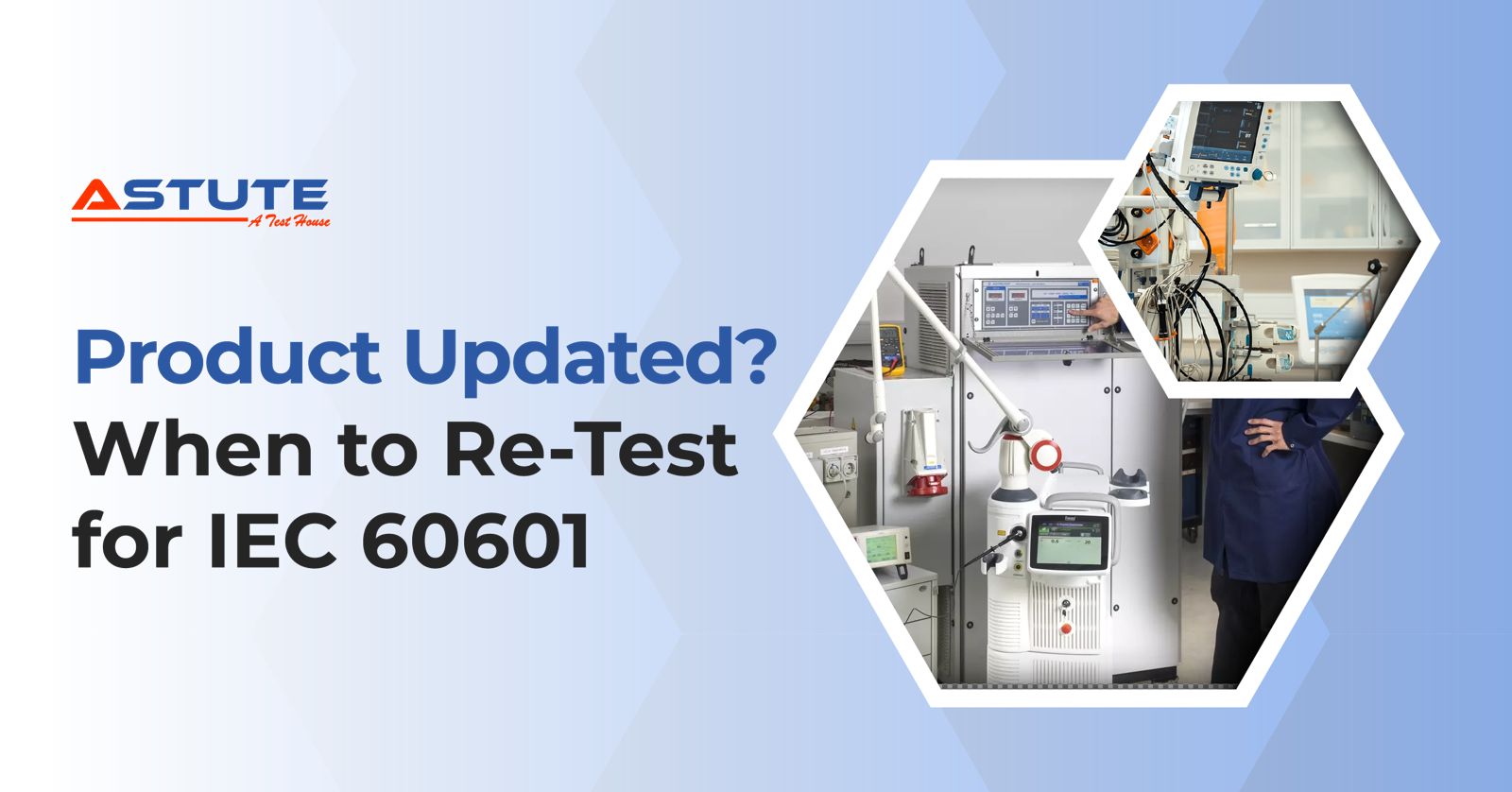
Medical electrical devices rarely remain unchanged after launch. Component availability shifts, suppliers change, PCB layouts are refined, power modules get replaced, and product teams continuously improve reliability and performance.
But every change creates the same compliance question:
Does this update still match the configuration covered by your existing IEC 60601 report, or do you need re-testing?
Some companies assume small changes don’t matter and ship without verification. Others panic and default to full re-testing for every revision. Both approaches create risk. The practical method is impact-based change management: decide whether the update needs documentation only, delta testing, or a new baseline IEC 60601 report.
This guide breaks down a real-world decision framework used in compliant product lifecycles.
What an IEC 60601 report is actually tied to
An IEC 60601 report is evidence for a specific tested build, including:
- electrical construction and insulation concept
- ratings and power architecture
- critical components
- enclosure design and protective barriers
- accessories/cables used during testing
- declared operating conditions
This matters because the report is not a permanent approval for a product family. It is proof that a controlled configuration met the requirements for basic safety and essential performance. If the product changes in a way that affects the safety evidence behind that configuration, the testing scope must be reviewed.
For a deeper understanding of how compliance builds from the ground up, refer to Astute’s detailed overview on IEC 60601-1 compliance for medical equipment.
The 3-tier decision framework for design changes
Most design changes fall into one of these three tiers:
Tier 0: Documentation-only change (no lab re-testing)
Tier 0 applies when the change clearly does not affect safety-critical construction, essential performance, or the tested configuration.
Typical examples:
- supplier swap for a non-critical screw or bracket with identical specifications
- label artwork changes that do not alter required safety markings
- component replacement with proven equivalence in a non-critical circuit
Even Tier 0 changes must be defensible. The justification should not be a casual internal note.
The key requirement:
This justification must be a formal update to your ISO 14971 Risk Management File, demonstrating that the change does not introduce new hazards or increase existing risk.
Tier 1: Delta testing (clause-focused re-testing)
Tier 1 is the most common category in real product lifecycles. The product isn’t fundamentally redesigned, but the change may impact specific clauses of IEC 60601.
Typical Tier 1 changes include:
- changing the PSU or power adapter model
- PCB revision near isolation boundaries, grounding paths, or thermal zones
- enclosure changes (resin/material changes, vents, seams, mounting updates)
- cable/connectors/accessories changes included in the original test setup
Rather than repeating full certification testing, Tier 1 follows a targeted approach:
- create a clause impact matrix
- perform focused delta tests
- update the report with the new evidence trail
If your team wants to minimize certification delays while maintaining compliance discipline, see: How to reduce medical device certification delays
Tier 2: New baseline IEC 60601 report
Tier 2 is required when the product has changed enough that the original report is no longer a clean representation of current production.
Common Tier 2 triggers:
- major redesign of electrical architecture
- change in the protection/insulation concept
- significant mechanical redesign that changes accessibility, shielding, or thermal behavior
- cumulative changes across subsystems that make the report difficult to defend
In these cases, a new baseline report is often more efficient and more defensible than stacking multiple incremental amendments.
If you’re planning a full re-evaluation or a next production baseline, the relevant service scope typically falls under:
Medical Device Testing services
A practical change classification table
Design Change Type | Example | Most Likely Tier | Typical Action |
Cosmetic/admin change | logo change on enclosure | Tier 0 | documentation + RMF update |
Non-critical supplier swap | same screw/material grade | Tier 0 | equivalence justification |
PSU/power adapter change | alternate power brick model | Tier 1 | delta tests + report update |
PCB revision near HV/isolation | layout updates | Tier 1 | spacing review + focused testing |
Enclosure resin/vent update | material/airflow change | Tier 1 | clause-focused mechanical/thermal checks |
Major redesign or accumulated changes | architecture update | Tier 2 | new baseline IEC 60601 report |
What labs evaluate first during change review
Before deciding testing scope, most labs focus on four core questions:
- Did safety-critical construction change?
Insulation barriers, spacing, protective earth bonding, protection components, fault behavior. - Did the tested system configuration change?
Cables, accessories, input ratings, enclosure openings, airflow paths. - Does the change intersect with essential performance or risk controls?
Meaning: could performance degrade into unacceptable risk under normal or fault conditions? - Do you have objective evidence?
Equivalence documentation, updated risk evaluation, and internal verification results.
A strong change file reduces uncertainty and keeps delta testing efficient.
The 3 change types that most often trigger re-testing
1) Power-related updates (PSU, adapter, charging path)
Power components are frequently treated as interchangeable because the output rating looks similar. In compliance terms, they are not interchangeable unless equivalence is proven.
Power changes can influence:
- leakage behavior at system level
- dielectric withstand performance across isolation
- thermal footprint and temperature rise
- response under fault conditions
Most PSU swaps require Tier 1 delta testing unless evidence proves true equivalence.
2) Enclosure changes that seem “cosmetic”
Enclosures are part of the safety design. Even a material update can impact:
- access to hazardous parts after impact or stress
- mechanical strength and stability
- heat dissipation and surface temperatures
- seam gaps affecting spacing consistency
These updates are commonly Tier 1.
3) PCB revisions and component substitutions
PCB updates can create second-order effects that don’t appear in functional testing:
- spacing changes affecting leakage paths
- new thermal hotspots
- grounding changes impacting safety margins
- noise coupling into sensitive control circuits
For electronics design updates, focused verification is usually the fastest and safest route.
For changes involving electronics, routing, shielding, or power circuits, manufacturers often require support from: EMI/EMC testing services
India-specific context: CDSCO MD-40 change submissions
For manufacturers in India, the design change decision is not only about IEC compliance. Many product updates also create anxiety about license continuity.
In practice, a Tier 2 change often triggers a Post-Approval Change submission (Form MD-40) with CDSCO. Aligning your updated test evidence and documentation early helps avoid approval delays and prevents compliance gaps.
To understand how test evidence fits into Indian regulatory workflows, refer to: CDSCO medical device testing process in India
If your update touches components that bring BIS implications into play, this reference may be helpful: BIS testing process for medical devices in India
A simple workflow to reduce retest surprises
A controlled change process typically follows these steps:
- Write a clear change summary (what changed, why, and where)
- Update ISO 14971 risk documentation (new hazards, changed probability/severity, affected controls)
- Build a clause impact matrix (which IEC 60601 areas are affected)
- Classify into Tier 0, Tier 1, or Tier 2
- Execute delta testing if Tier 1, or baseline report creation if Tier 2
- Maintain clean configuration control (BOMs, drawings, revision history)
This workflow prevents over-testing, avoids under-testing, and keeps your report defensible.
The decision you want to be able to defend
A strong compliance decision is one you can defend clearly:
- the change was controlled and documented
- risk impact was evaluated
- clause impact was mapped
- testing matched the real impact
- your updated report trail is clean
If you want a structured design change review and a testing plan mapped to your updated configuration, contact Astute Labs here: Contact Astute Labs