Alarm integrity is an essential performance, not an accessory
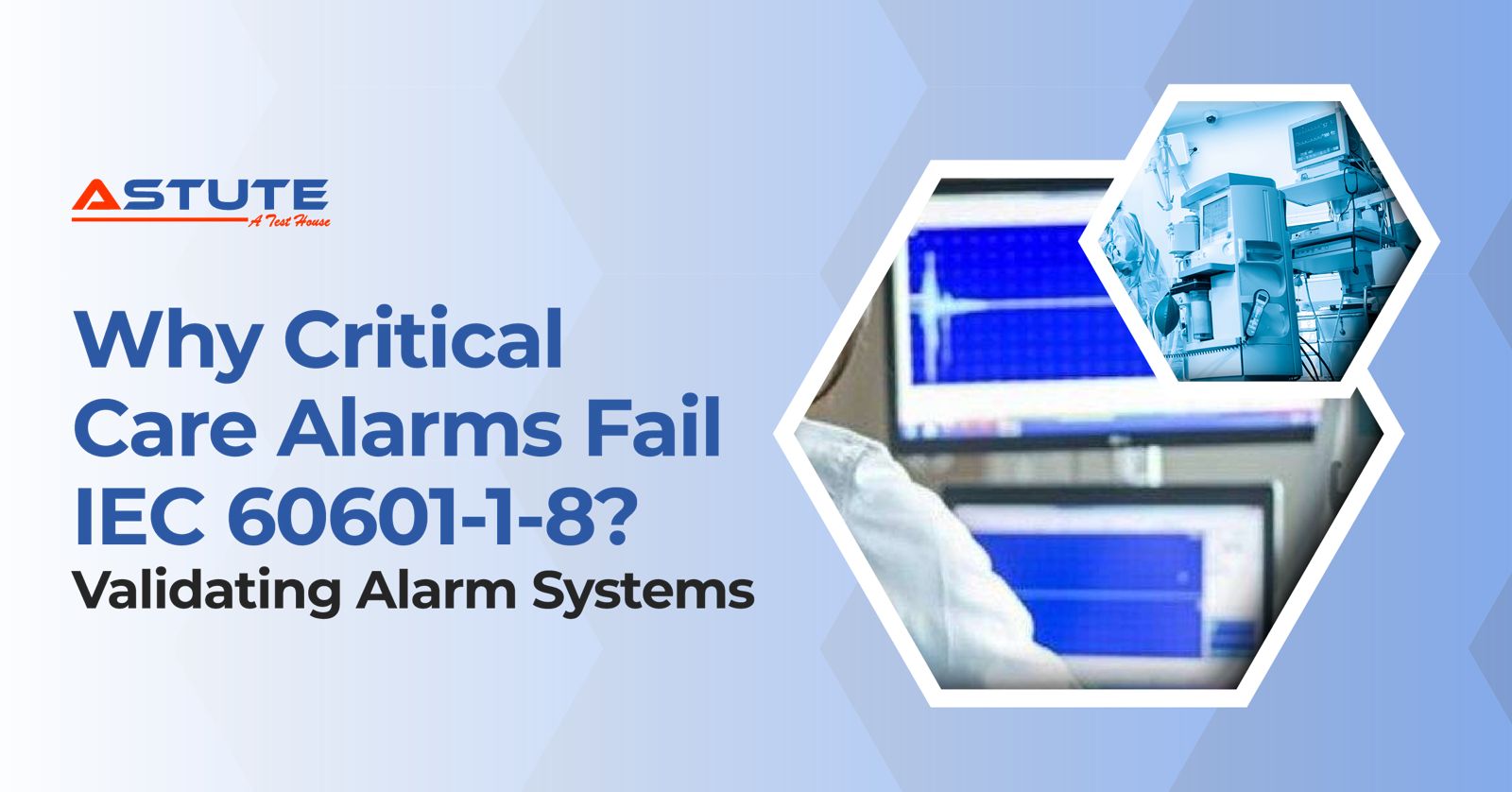
In critical care environments such as ICUs, alarm systems are not secondary features. They are the primary mechanism that converts device data into clinical action. When a ventilator disconnects, an infusion line occludes, or cardiac rhythm deteriorates, the alarm system is often the only safeguard that triggers intervention.
IEC 60601-1 defines Essential Performance as performance whose loss or degradation results in unacceptable risk. For ventilators, monitors, and infusion devices, alarm annunciation is inseparable from essential performance. This relationship is evaluated during IEC 60601-1 safety and performance compliance testing, which forms the baseline for medical electrical equipment approval.
A device that continues operating silently during a hazardous condition is functionally unsafe, even if its core electronics remain intact. Regulatory reviewers now expect manufacturers to demonstrate not only the presence of alarms, but their effectiveness under realistic clinical conditions.
What IEC 60601-1-8 actually requires you to validate
IEC 60601-1-8 governs alarm systems across auditory signals, visual indicators, and alarm logic. These requirements are assessed alongside broader medical device testing services that evaluate safety, performance, and risk alignment at a system level.
Most non-conformities occur when these elements are validated independently rather than as a complete alarm system.
Auditory alarms behave differently once the product is assembled
Alarm tones that appear compliant during firmware or bench testing often fail once integrated into the final enclosure. Housing design, speaker placement, grille geometry, and internal components significantly affect acoustic behavior.
These issues are commonly identified during pre-compliance EMC testing, where enclosure resonance, interference, and processor load reveal instability in alarm sound output.
IEC 60601-1-8 requires multiple dominant frequency components within a defined band, with controlled amplitude variation. Validation must therefore be performed on the fully assembled, production-equivalent unit rather than early mechanical prototypes.
Visual alarms must be visible in real clinical lighting
Visual indicators must guide clinicians to the alarm source in multi-device environments. The standard requires alarm presence and priority to be perceivable from defined distances under realistic ambient lighting and viewing angles.
These requirements are often overlooked unless testing reflects critical care device safety validation practices. Indicators that appear bright in laboratory settings may wash out under operating theater lighting or off-axis viewing.
Priority logic is closely scrutinized
Alarm priorities must correlate directly with clinical risk. Overuse of high-priority alarms increases alarm fatigue, while downgrading urgent conditions creates unacceptable risk.
Regulators assess alarm priority handling alongside risk management and usability expectations, especially when multiple alarms occur simultaneously. High-priority alarms must always dominate audible and visual annunciation.
Common alarm system failures seen during testing
The following issues account for many IEC 60601-1-8 non-conformities identified during evaluations at accredited medical device testing laboratories.
Failure area | Why it happens | What validation must demonstrate |
Acoustic non-compliance | Enclosure resonance distorts frequency balance | Harmonic structure remains compliant in final assembly |
Timing jitter | Alarm generation competes with UI or communication tasks | Stable pulse and burst timing under full CPU load |
Visual washout | Indicators optimized for laboratory lighting | Visibility under high ambient light |
Priority conflicts | Incomplete alarm stacking logic | The highest priority always dominates the announcement |
Network dependency | Assumed ideal connectivity | Local fallback when communication fails |
Distributed alarm systems introduce new risk paths
Modern critical care devices increasingly forward alarms to central stations, middleware platforms, or mobile communicators. This creates distributed alarm systems where latency, packet loss, and acknowledgment handling directly affect patient safety.
These risks intersect with EMI and EMC behavior in medical devices, making coordinated system-level validation essential.
Validation must measure total alarm delivery time from physiological event to clinician notification and include simulated network failure scenarios.
Usability validation is now inseparable from alarm compliance
Even technically compliant alarms can fail if clinicians misunderstand or ignore them. IEC 60601-1-8 therefore aligns closely with usability engineering expectations.
This scrutiny mirrors regulator focus during the CDSCO medical device approval process in India, where alarm recognition and response are increasingly examined.
Validation must confirm that users can correctly identify alarm source, priority, and required action in realistic clinical environments.
Indian regulatory context for alarm validation
For manufacturers targeting India, IEC 60601-1-8 is adopted under IS 13450 (Part 1/Section 8). Critical care devices typically fall under Class C or D.
Alarm system evidence must align with medical device testing requirements based on risk classification and be supported by NABL-accredited test reports reflecting final configuration testing.
Where Astute Labs fits in
Reducing rework during certification testing depends on early, configuration-aware validation. Involving a test laboratory before formal runs allows teams to identify acoustic, visual, and logic issues while corrective changes are still feasible.
Astute Labs supports manufacturers through EMI and EMC testing services and integrated medical device testing services, helping resolve alarm compliance gaps before certification testing begins.
To discuss device configuration, intended use environment, or alarm validation planning, Contact us.