Electrical Safety and Functional Reliability
Endoscopic Equipment Testing for Minimally Invasive Devices
Endoscopic systems are widely used in minimally invasive procedures across gastroenterology, urology, laparoscopy, and other clinical specialties. These devices combine optics, illumination, electronics, imaging systems, reusable accessories, and patient-contacting components in one setup.
That makes testing more complex than basic electrical safety.
Endoscopic systems combine electrical safety, functional reliability, and sterilization-linked risk in one device ecosystem. IEC 60601-2-18 addresses these risks by defining safety and performance requirements specific to endoscopic equipment.
For manufacturers, this standard is important because endoscopic devices are used inside or close to the patient’s body. Any failure in insulation, image quality, light output, or device reliability can directly affect patient safety and regulatory approval.
IEC 60601-2-18 Endoscopic Equipment Testing Requirements
IEC 60601-2-18 is a particular standard within the IEC 60601 framework. It works with:
- IEC 60601-1
- IEC 60601-1-2
- ISO 14971
A key shift in this standard is the focus on essential performance, especially reliable visualization during procedures. Loss of image or incorrect orientation is treated as a safety risk, not just a performance issue .
Key Testing Areas Under IEC 60601-2-18
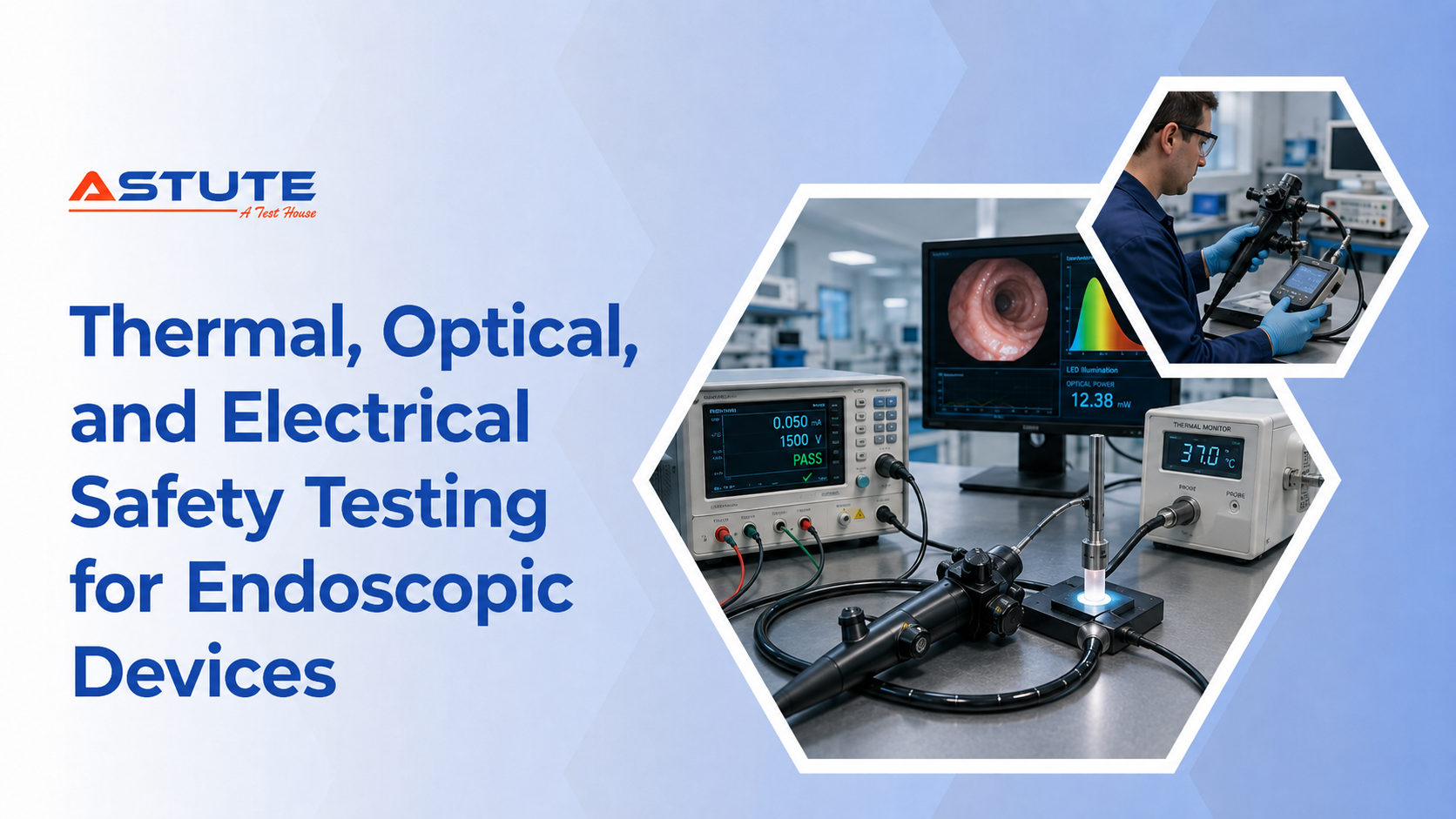
Endoscopic equipment brings together electrical parts, imaging systems, light sources, and reusable components. Testing under IEC 60601-2-18 evaluates how these systems perform together during real clinical use.
Testing Area | What Is Checked | Why It Matters |
Electrical Safety | Leakage current, insulation resistance, dielectric strength, grounding continuity, and single fault safety | Prevents unsafe electrical exposure, especially during internal use |
Functional Reliability | Image clarity, stability, orientation accuracy, latency, color consistency, and continuous operation | Ensures clinicians receive a clear and reliable view during procedures |
Thermal and Optical Safety | Distal tip temperature, light output, optical radiation risk, warnings, and safety controls | Reduces risk of tissue burns and excessive light exposure |
Sterilization and Reprocessing Impact | Material durability, insulation integrity, seals, lenses, and repeated cycle performance | Confirms device safety and performance over its reusable lifecycle |
This approach ensures testing reflects actual usage conditions, not just lab scenarios.
Electrical Safety and High-Frequency Risk in Endoscopic Equipment
Endoscopic devices often interact with high-frequency surgical tools. This creates additional risks such as unintended energy transfer through insulation gaps.
Electrical safety testing therefore goes beyond basic checks. It evaluates how the system behaves when used alongside other surgical equipment and under fault conditions.
For manufacturers, this means designing and testing for real-world operating environments, not just ideal conditions.
Functional Reliability in Endoscopic Imaging Systems
Endoscopic procedures depend heavily on visualization. Any disruption in image quality can affect clinical decisions.
Testing ensures:
- Stable image output
- Correct orientation
- Minimal delay between movement and display
This becomes more critical with modern systems using HD, 4K, and fluorescence imaging, where performance expectations are higher.
Thermal and Optical Safety in Endoscopic Devices
High-intensity light sources are necessary for visibility but introduce heat and optical risks.
Testing evaluates whether:
- The distal tip temperature stays within safe limits
- Light exposure remains controlled
- Proper warnings and safety measures are in place
These checks help prevent tissue damage during prolonged procedures.
Sterilization and Reprocessing Impact on Endoscopic Equipment
Endoscopic devices are often reused and exposed to repeated cleaning and sterilization cycles.
Over time, this can affect:
- Insulation
- Mechanical strength
- Optical clarity
Testing ensures that the device continues to meet safety and performance requirements even after multiple reprocessing cycles.
EMC Testing for Endoscopic Equipment in Clinical Environments
Endoscopic systems operate in electrically dense environments. They may be used near electrosurgical units, monitors, robotic systems, wireless devices, and other medical equipment.
EMC testing helps confirm that the endoscopic system does not interfere with nearby devices and does not lose essential performance when exposed to electromagnetic disturbances.
For example, the image should not drop, flicker, freeze, or distort when other equipment is operating nearby. Astute Labs supports this through EMI/EMC testing for medical devices.
Endoscopic Equipment Testing for Regulatory Compliance
IEC 60601-2-18 supports global regulatory readiness for endoscopic equipment. It is relevant for CDSCO submissions in India, CE marking under MDR, and FDA pathways.
Testing with an accredited lab helps manufacturers identify gaps early, reduce rework, and prepare stronger technical documentation.
Astute Labs supports manufacturers through medical device testing services covering safety and performance requirements for medical electrical equipment. You can also refer to their guide on IEC 60601-1 compliance for broader safety context.
Endoscopic Equipment Testing for Safer Clinical Performance
Endoscopic equipment must be safe, reliable, and durable across real clinical use.
IEC 60601-2-18 focuses on electrical safety, image reliability, thermal control, optical safety, and performance after reprocessing. For manufacturers, early testing helps reduce approval delays and improves confidence in device safety.
Working with Astute Labs helps manufacturers validate these requirements with structured, standards-aligned testing. Contact us