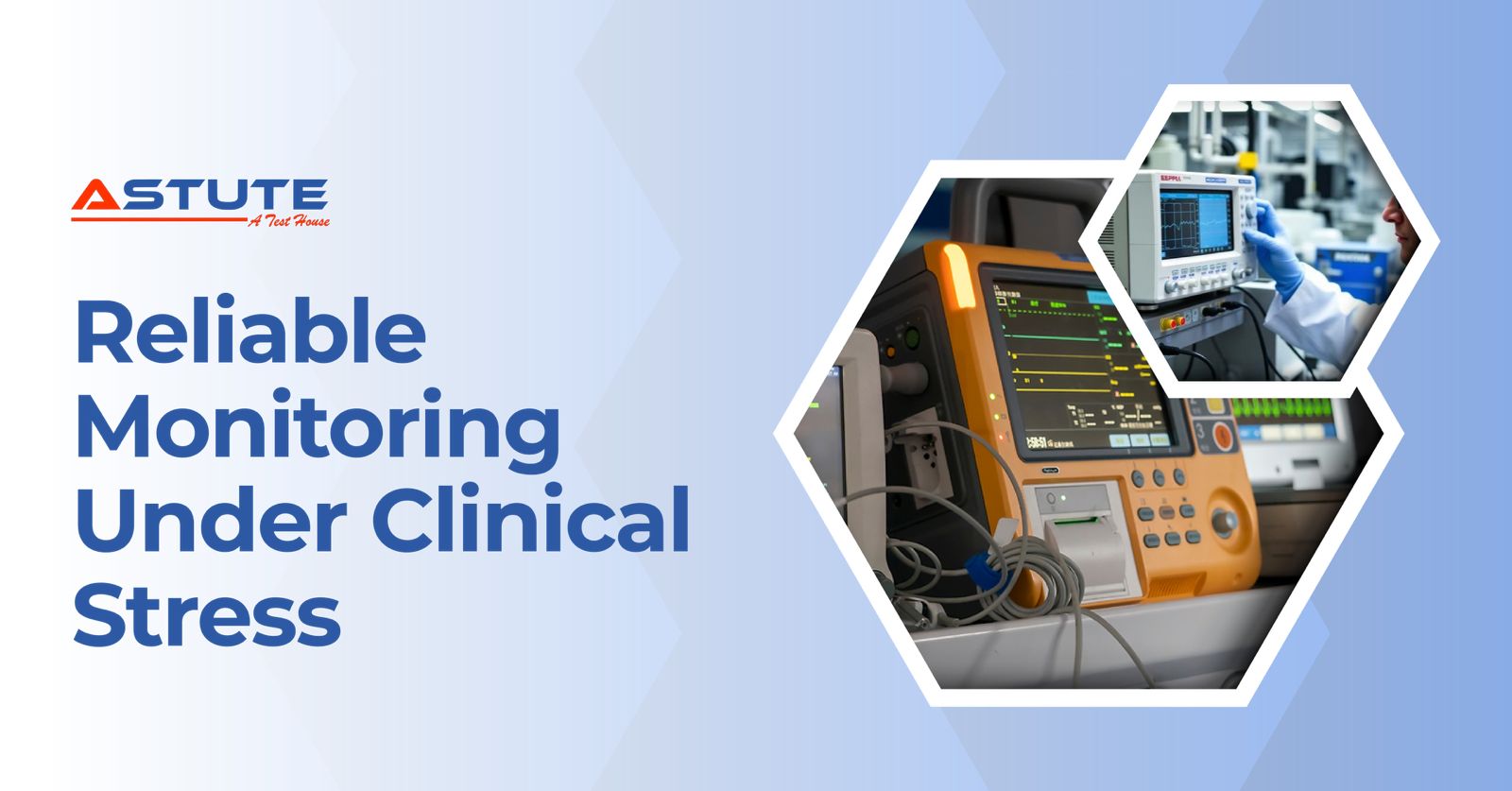
Modern patient monitoring systems are no longer simple bedside ECG displays. They are integrated platforms combining ECG, SpO₂, NIBP, temperature, invasive pressure, and sometimes capnography into a single device.
From a regulatory and engineering perspective, the difference between basic safety and essential performance becomes critical.
Two particular standards define this landscape:
- IEC 60601-2-27 for ECG monitoring equipment
- IEC 80601-2-49 for multifunction patient monitors
For manufacturers in India seeking CDSCO, BIS, and NABL-aligned compliance, understanding the interaction between these standards is essential.
Understanding the Regulatory Architecture
All cardiac and multiparameter monitors are built on a layered compliance structure.
Foundational Standards
Standard | Scope | Why It Matters |
IEC 60601-1 | General safety and essential performance | Baseline electrical safety |
IEC 60601-1-2 | EMC requirements | Immunity to EMI, ESU, RF, power disturbances |
IEC 60601-1-8 | Alarm systems | Alarm priority and usability |
IEC 60601-1-11 | Home healthcare | If intended for home use |
IEC 60601-1-12 | EMS environment | For ambulance/transport use |
For ECG monitoring:
- IEC 60601-2-27 applies.
For systems combining multiple physiological modules:
- IEC 80601-2-49 applies at system level.
It is important to understand that IEC 80601-2-49 does not replace module standards. It manages integration risks when multiple parameters operate simultaneously.
For detailed guidance on general medical electrical safety, refer to our blog on IEC 60601-1 compliance guide for medical equipment.
What IEC 60601-2-27 Really Tests in Cardiac Monitors
IEC 60601-2-27 applies to continuous ECG monitoring equipment used in hospitals, ambulances, and similar environments.
It focuses on rhythm detection reliability and protection during high-risk events.
Core Essential Performance Requirements
1. Accurate QRS Detection and Heart Rate Calculation
The monitor must correctly detect QRS complexes under varying signal amplitudes and noise conditions.
2. Signal Linearity
Linearity testing is done by scaling test waveforms from full-scale to reduced amplitudes.
Requirement:
- Output must remain within ±20 percent of expected value across defined scaling steps.
3. Dynamic Range and DC Offset Tolerance
The device must function correctly with:
- ±300 mV differential DC offset
This prevents saturation due to electrode polarization effects.
ECG Performance Benchmarks Under IEC 60601-2-27
Parameter | Requirement |
System Noise (Peak-to-Peak) | ≤ 30 µV |
System Noise (RMS) | ≤ 15 µV |
Input Impedance | ≥ 2.5 MΩ |
CMRR | Approx. 89 to 93 dB |
Inter-channel Crosstalk | < 2 percent |
Resolution | ≥ 5 µV |
Slew Rate Capability | 125 mV/s |
These values ensure reliable rhythm detection without false alarms or missed arrhythmias.
If input impedance is too low, signal attenuation occurs at the electrode interface. The standard verifies this using a 620 kΩ resistor in parallel with a 4.7 nF capacitor inserted in the signal path.
Frequency Response and Clinical Implications
Different monitoring modes require different bandwidth settings.
Use Mode | Typical Bandwidth |
Diagnostic Monitoring | 0.05 Hz to 150 Hz |
Continuous Bedside Monitoring | 0.5 Hz to 40 Hz |
ST-Segment Monitoring | 0.05 Hz low-frequency response required |
Improper filtering can:
- Mask ischemic changes
- Cause ST distortion
- Create false tachycardia alarms
This is why EMC and filtering behavior must be validated alongside electrical safety.
Learn more about electromagnetic compliance in our detailed article on IEC 60601-1-2 EMC testing for medical devices.
Defibrillator Protection and Recovery Testing
Cardiac monitors must survive high-energy defibrillation pulses.
Testing involves:
- 5000 V defibrillator pulse simulation
- Leakage current verification post-shock
- Recovery time assessment
The monitor must:
- Remain electrically safe
- Not allow hazardous patient leakage current
- Resume normal ECG display quickly
Failure in this area leads to serious nonconformities during regulatory review.
Pacemaker Pulse Rejection Requirements
The monitor must not count pacemaker pulses as QRS complexes.
Test parameters typically include:
Parameter | Range |
Pulse Amplitude | ±2 mV to ±700 mV |
Pulse Width | 0.1 ms to 2.0 ms |
Rise Time | 10 µs to 100 µs |
False counting could mask asystole, which is a life-threatening risk.
What IEC 80601-2-49 Adds for Multiparameter Monitors
When a monitor integrates ECG, SpO₂, NIBP, temperature, and other modules, additional system-level requirements apply.
IEC 80601-2-49 ensures:
- No cross-interference between parameters
- Alarm priority consistency
- Validity indication for unreliable values
- Coordinated behavior during shared hardware failures
Multiparameter System-Level Risk Areas
1. Cross-Talk and Interference
High-frequency currents from ESU or other modules must not corrupt ECG or SpO₂ signals.
2. Simultaneous Monitoring Validation
Testing must confirm:
- ECG, respiration, and SpO₂ operate correctly at the same time
- No data synchronization errors occur
3. Alarm System Harmonization
Alarm priority classification must follow IEC 60601-1-8:
Priority | Visual Signal | Clinical Meaning |
High | Red flashing | Immediate life threat |
Medium | Yellow flashing | Prompt attention required |
Low | Cyan steady | Technical alert |
Monitors must also indicate when a parameter value is unreliable instead of displaying potentially incorrect readings.
Environmental Robustness and IP Testing
Patient monitors must withstand:
- Liquid spills
- Cleaning chemicals
- Mechanical stress
Spill testing is conducted under IEC 60601-1 Clause 11.6.3.
IP ratings such as IPX1 or IPX4 are often required depending on intended environment.
Risk Management Integration
IEC 60601 standards require alignment with ISO 14971 risk management.
Common compliance pitfalls include:
Pitfall | Consequence |
Late ESU testing | Hardware redesign |
Ignoring alarm integration | Audit findings |
Poor documentation linking risk to test data | Certification delays |
Inadequate EMC pre-testing | Failure during formal testing |
Pre-compliance testing significantly reduces risk. Learn how in our blog on Pre-compliance EMC testing for medical devices.
The Emerging Consolidation Under IEC 80601-2-86
The industry is moving toward harmonization of ECG diagnostic, monitoring, and ambulatory systems under IEC 80601-2-86.
Future revisions are expected to integrate:
- Software life cycle requirements
- Cybersecurity considerations
- Integrated electrode and cable requirements
Manufacturers must prepare for Edition 3.2 transition impacts under IEC 60601-1 Amendment 2.
Why Structured Compliance Planning Matters in India
For devices marketed in India, certification pathways typically involve:
- NABL-accredited laboratory testing
- BIS recognition (if applicable)
- CDSCO documentation alignment
Selecting the right laboratory early avoids retesting delays. You may refer to our guide on choosing the right medical device testing lab.
Astute Labs supports medical device manufacturers in India with structured validation programs, worst-case configuration planning, and evidence-based compliance documentation aligned with IEC 60601 standards.
If you are planning type testing, design validation, or regulatory submission for cardiac or multiparameter monitors, connect with our technical team through Contact Us
Frequently asked questions
01. Is IEC 60601-2-27 enough for a multiparameter monitor?
02. What is the most common failure during cardiac monitor testing?
- Input impedance non-compliance
- Defibrillation recovery issues
- Alarm timing deviations
- Excess noise during EMC immunity testing