Signal Accuracy and Patient Leakage Current Compliance Explained
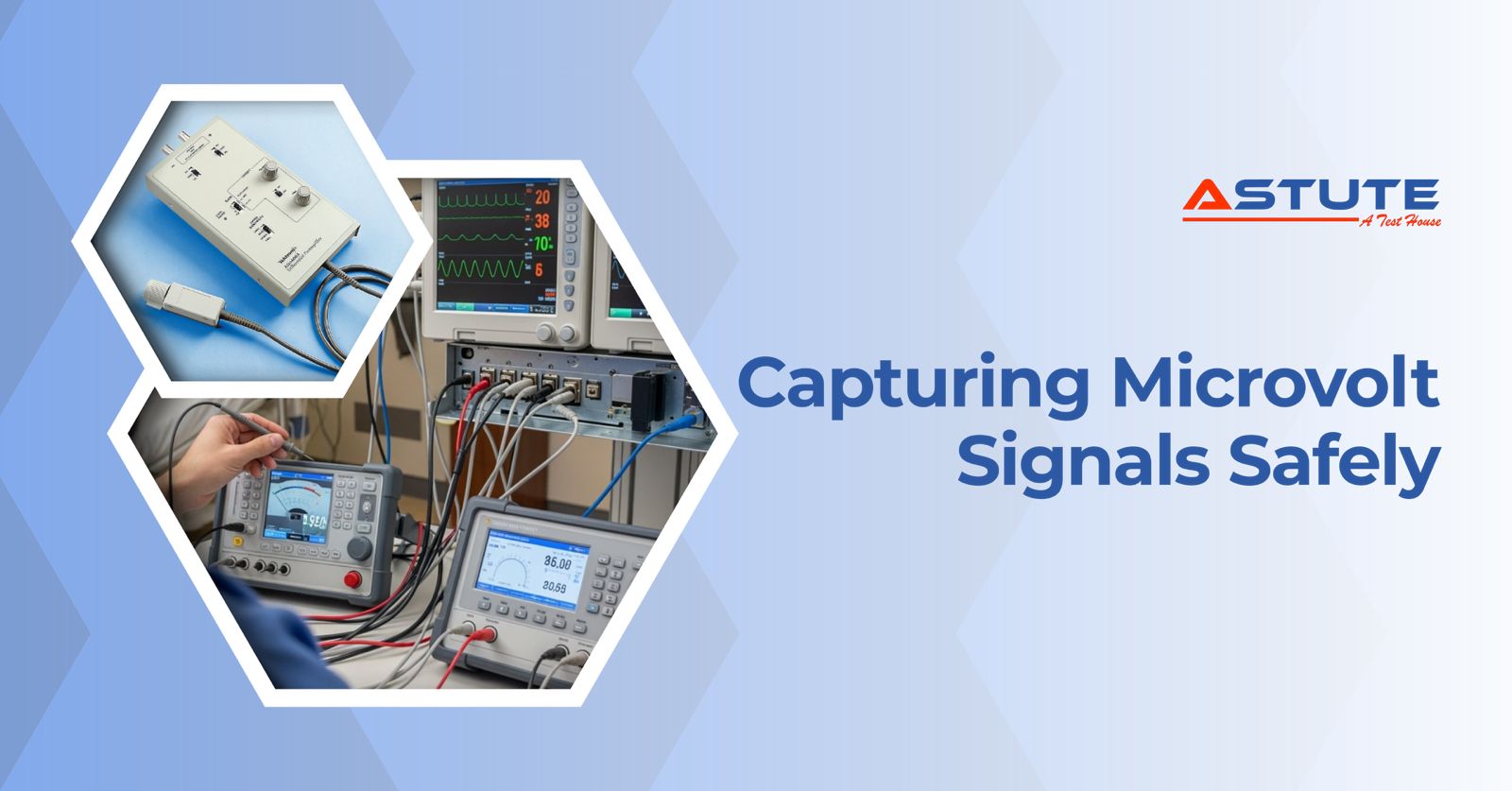
Electrocardiographs operate in the microvolt range. A minor distortion in amplitude, timing, or filtering can directly affect a clinical diagnosis. IEC 60601-2-25 defines the essential performance and electrical safety requirements for diagnostic ECG systems and works together with the general safety standard covered in our guide on IEC 60601-1 compliance for medical equipment.
For regulatory and quality teams, compliance is not only about passing an electrical test. It is about proving that the diagnostic report generated by the ECG machine remains clinically accurate and electrically safe under all operating conditions.
Where IEC 60601-2-25 Fits in the Regulatory Structure
IEC 60601-2-25 is a particular standard under the IEC 60601 family. It extends:
- IEC 60601-1 for basic safety and essential performance
- IEC 60601-1-2 for electromagnetic compatibility
- ISO 14971 for risk management integration
If you want a deeper understanding of how EMC requirements interact with medical safety, refer to our article on IEC 60601-1-2 EMC testing for medical devices.
In India, compliance with these standards is typically evaluated through NABL-accredited laboratories as part of CDSCO or BIS documentation.
Essential Performance in Diagnostic ECG Systems
In diagnostic ECG equipment, essential performance includes:
- Accurate waveform acquisition
- Correct measurement of PR, QRS, QT intervals
- Reliable ST-segment representation
- Proper indication of saturation or malfunction
Unlike cardiac monitors, diagnostic ECG machines must preserve waveform morphology with high precision. Any deviation may result in misdiagnosis.
Signal Accuracy Requirements Under IEC 60601-2-25
Cardiac electrical signals are extremely small. The system must amplify and digitize them without introducing distortion.
Key Performance Parameters
Parameter | Typical Requirement | Clinical Importance |
Internal Noise (pk-pk) | ≤ 30 µV | Prevents false arrhythmia interpretation |
Sampling Frequency | ≥ 500 samples/sec | Preserves QRS morphology |
Resolution | ≤ 5 µV per LSB | Detects subtle ST shifts |
Dynamic Range | ± 5 mV | Prevents clipping of large signals |
Inter-channel Skew | < 100 µs | Maintains lead synchronization |
CMRR | 90–100 dB | Rejects 50/60 Hz interference |
Failure to meet these values can lead to missed myocardial infarction detection or incorrect QT prolongation assessment.
Input Impedance Validation
IEC 60601-2-25 mandates a minimum differential input impedance of 2.5 MΩ.
Testing is performed at multiple frequencies and electrode configurations to verify signal stability. Low impedance can attenuate waveform amplitude and distort diagnostic features.
Algorithm Validation Using Standardized Databases
The standard requires validation against waveform databases to ensure automated measurement accuracy.
CTS Database
Artificial waveforms used to verify amplitude and interval calculations.
CSE Database
Real patient recordings annotated by cardiologists. These validate:
- PR interval
- QRS duration
- QT interval
- Heart rate measurement
This requirement ensures that automated ECG interpretation remains clinically reliable.
Electrical Safety: Type CF Applied Parts
ECG electrodes are typically classified as Type CF applied parts, the highest protection category under IEC 60601.
Because electrodes create a conductive path to the patient’s body, leakage current limits are extremely strict.
Patient Leakage Limits
Condition | Type CF Limit |
Normal Condition | 10 µA |
Single Fault Condition | 50 µA |
These limits protect against microshock, particularly in patients with invasive cardiac lines.
For a broader overview of safety testing expectations in India, you may refer to NABL medical device testing under IEC 60601.
Patient Auxiliary Current Testing
This test measures current flowing between electrodes on the same patient.
It ensures:
- Lead-off detection currents remain safe
- No unintended cardiac stimulation occurs
- Isolation between leads is maintained
Mains on Applied Part Isolation
This test simulates accidental exposure of ECG electrodes to mains voltage.
The ECG system must maintain reinforced isolation so that hazardous current does not flow into the patient. This is verified under both normal and single fault conditions.
EMC and Diagnostic Integrity
An ECG machine must remain diagnostically accurate even during electromagnetic disturbance. Testing verifies performance during:
- Electrostatic discharge
- RF exposure
- Electrical fast transients
- Conducted disturbances
Devices must maintain essential performance, not merely continue operating.
Manufacturers who want to reduce late-stage failures often begin with pre-compliance EMC testing to identify issues early.
Common Compliance Observations in ECG Testing
- Saturation warning not triggered correctly
- Input impedance close to limit at higher frequencies
- Filtering distorting ST segment
- Leakage exceeding limits in single fault condition
- Inter-channel timing mismatches
Addressing these issues early reduces certification delays, as discussed in how to reduce medical device certification delays.
Why Professional Testing Infrastructure Is Critical
Diagnostic ECG validation requires:
- Multi-channel synchronized ECG simulators
- Microvolt-accurate waveform injection
- Leakage current analyzers
- Isolation verification systems
Selecting the right lab partner significantly affects project timelines. If you are evaluating testing partners, see our guide on choosing the right medical device testing lab.
What RA and QA Teams Should Ensure in Documentation
Your technical file should include:
- Signal accuracy validation data
- CTS and CSE database comparison reports
- Leakage current test results under NC and SFC
- Isolation and dielectric strength reports
- EMC essential performance validation
- Updated risk management linkage
Incomplete or inconsistent documentation often results in regulatory queries.
Ensuring Diagnostic Accuracy Starts with the Right Testing Partner
ECG compliance under IEC 60601-2-25 is not only about passing electrical safety limits. It is about proving signal integrity, algorithm accuracy, and patient isolation under real-world conditions. A structured validation approach helps prevent regulatory delays, redesign cycles, and clinical risk exposure.
If you are developing or upgrading a diagnostic ECG system and need structured testing aligned with IEC 60601-2-25 and Indian regulatory expectations, speak with our technical team at Astute Labs to plan your compliance strategy with clarity and confidence.
Frequently asked questions
01.What is the most critical safety requirement for ECG machines?
Patient leakage current limits under Type CF classification are the most stringent and non-negotiable.