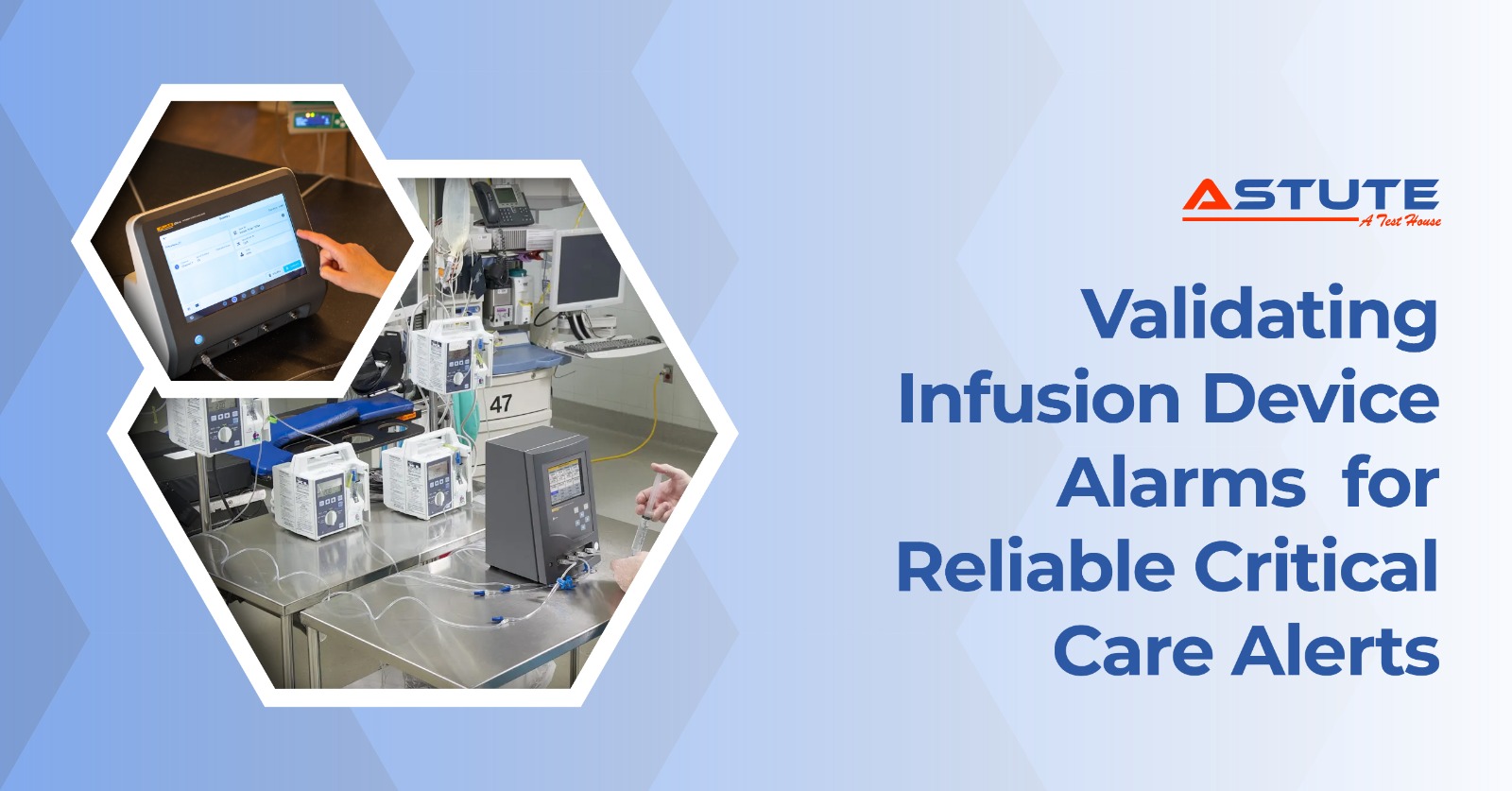
In infusion therapy, the alarm is often the first indication that something is wrong. Whether it is an occlusion, air in line, or interruption in drug delivery, timely alerts are critical to patient safety.
Infusion pumps are widely used in ICUs, emergency care, and surgical settings where even a minor delay can lead to serious outcomes. A device may deliver fluids accurately, but without a reliable alarm system, risks remain undetected.
IEC 60601-1-8 addresses this gap by standardizing alarm systems across medical electrical equipment. It ensures that alarms are not only functional but also recognizable, timely, and consistent across devices used in critical care environments.
What IEC 60601-1-8 Covers
IEC 60601-1-8 is a collateral standard that defines requirements for alarm systems across a wide range of medical devices. Its goal is to reduce confusion and improve response time by making alarm behavior predictable.
The standard focuses on:
- Alarm priority classification
- Audible and visual signal design
- Alarm timing and response behavior
- Usability in real clinical environments
To understand how alarm systems integrate with overall device safety, refer to the IEC 60601-1 compliance guide for medical equipment.
Alarm Priority Classification
A core requirement of IEC 60601-1-8 is assigning the correct priority to each alarm based on clinical risk.
Alarm Priority Levels
Priority | Meaning | Example Conditions |
High | Immediate risk to patient | Occlusion, air-in-line, system failure |
Medium | Potential risk | Flow interruption, low battery |
Low | Informational | Near end of infusion |
Each level must have clearly distinguishable signals. If alarm tones or visual indicators overlap, clinicians may misinterpret urgency, which increases risk.
Audible and Visual Alarm Requirements
The standard defines how alarms must be perceived by users in real-world conditions.
Audible Alarm Testing
Validation includes:
- Sound pressure levels within defined ranges
- Distinct tone patterns for each priority level
- Consistency of sound across operating modes
Visual Alarm Testing
Includes:
- Flashing indicators
- Clear color differentiation
Typical Visual Mapping
Color | Priority |
Red | High |
Yellow | Medium |
Blue or White | Low |
These signals must remain visible and identifiable even in low-light or high-activity environments.
Alarm Response and Timing Validation
Alarm timing is critical in infusion devices. Even a small delay can impact patient outcomes.
Testing ensures that alarms are triggered within defined limits once a hazardous condition is detected.
Response Validation Overview
Parameter | Requirement |
Detection time | Within defined thresholds |
Activation delay | Minimal and consistent |
Alarm persistence | Continues until addressed |
Examples include detecting occlusions, identifying air in line, and triggering alerts for flow interruptions.
A delayed alarm is considered a failure of essential performance, regardless of other device functions.
Alarm Behavior Under Fault Conditions
Infusion devices must maintain alarm functionality even during internal faults.
Testing scenarios include:
- Power supply fluctuations
- Sensor malfunctions
- Software errors
The alarm system must remain active and reliable under these conditions. This requirement ensures that faults do not silently compromise patient safety.
To understand how such conditions are validated, refer to an accredited medical device testing lab and insights on ISO IEC 17025 and IEC 60601 EMC test report quality in India.
Human Factors and Usability
Alarm systems are designed for real users operating in complex environments. IEC 60601-1-8 places strong emphasis on usability.
In ICUs and emergency settings:
- Multiple devices generate alarms simultaneously
- Background noise levels are high
- Clinicians rely on quick recognition rather than detailed analysis
Testing ensures that:
- Alarm tones are distinguishable from each other
- Visual signals are clearly visible
- Alarm fatigue is minimized
Excessive or poorly designed alarms can lead to desensitization, where critical alerts are ignored. This makes usability validation a key part of compliance.
Regulatory Expectations in India
Infusion pumps are typically classified as moderate to high risk devices under Indian regulations and require CDSCO approval.
Regulators expect:
- Alarm validation aligned with risk analysis
- Evidence of response timing compliance
- Clear differentiation between alarm priorities
- Integration with usability and safety engineering
Manufacturers should align with the CDSCO approval process for medical devices in India and understand medical device testing requirements by class when preparing submissions.
Common Manufacturer Mistakes
Several issues frequently lead to delays in compliance:
- Incorrect classification of alarm priority
- Weak differentiation between alarm tones
- Delayed or inconsistent alarm triggering
- Overuse of low-priority alerts
- Incomplete documentation of alarm logic
These gaps often result in repeated testing cycles and regulatory queries.
How Astute Labs Can Support
Alarm validation requires a combination of acoustic testing, electrical safety validation, and usability assessment.
Astute Labs supports manufacturers with medical device testing services and EMI EMC testing services.
These services help ensure that alarm systems perform reliably under real-world conditions and meet regulatory expectations in India. Contact us