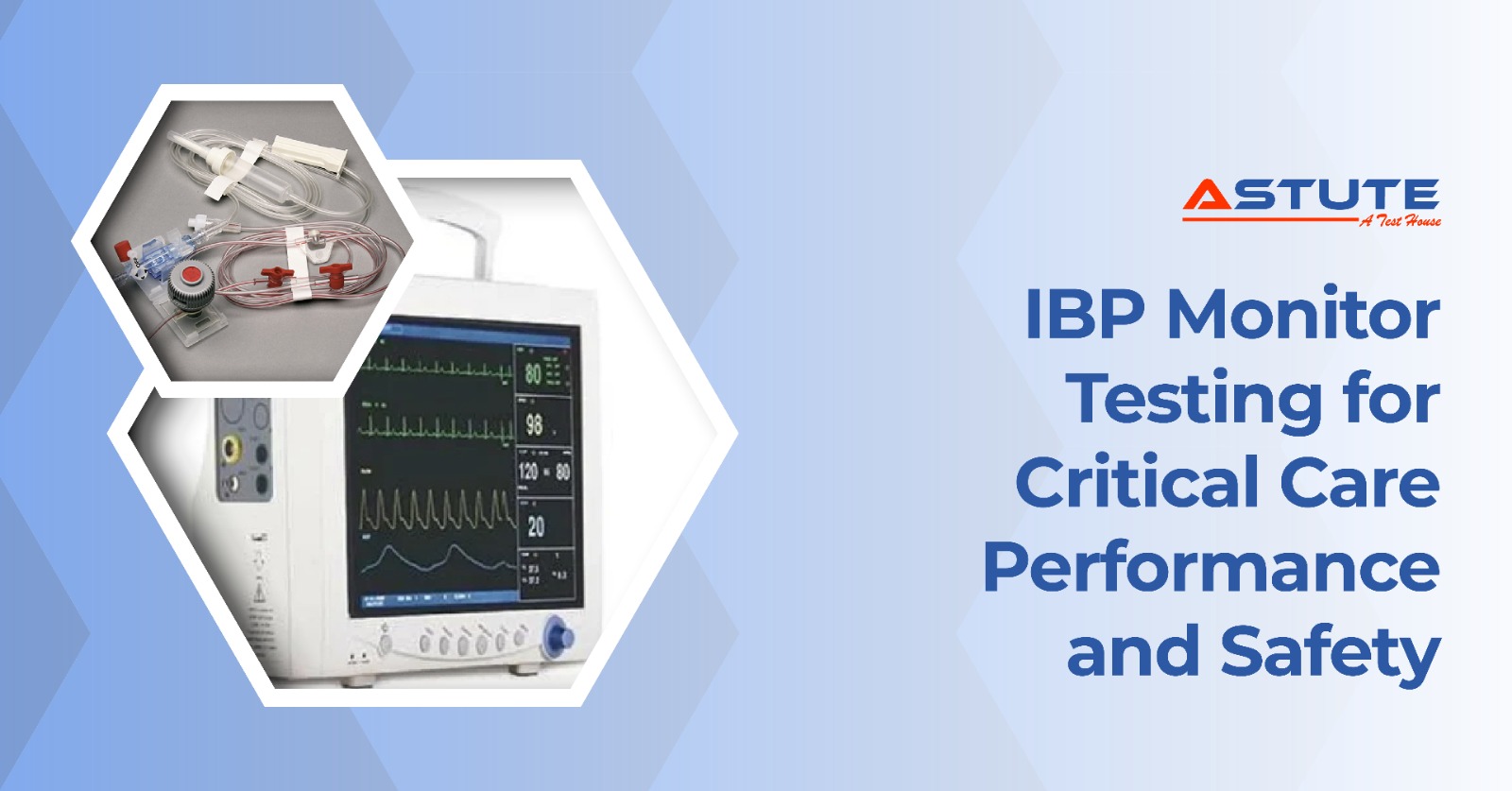
Invasive Blood Pressure Monitoring Equipment Testing for Critical Care Accuracy
Invasive blood pressure monitoring is used in ICUs, operating rooms, emergency care, and critical care transport to provide continuous, beat-to-beat pressure data.
Unlike non-invasive blood pressure monitors, IBP systems are connected to a fluid-filled pressure pathway that reflects arterial or venous pressure directly. This makes accuracy, waveform reliability, and electrical isolation critical.
IEC 60601-2-34 defines how invasive blood pressure monitoring equipment should be tested for safe and reliable performance in high-risk clinical environments.
IEC 60601-2-34 Testing Requirements for IBP Monitors
IEC 60601-2-34 is the particular standard for invasive blood pressure monitoring equipment under the IEC 60601 framework. It works with IEC 60601-1 for general electrical safety, IEC 60601-1-2 for EMC, and IEC 60601-1-8 for alarm systems.
The latest IEC 60601-2-34:2024 edition updates the earlier 2011 version and places stronger focus on emergency medical service environments, ingress protection, and updated essential performance requirements. These updates are important because IBP monitors may be used in demanding environments where movement, fluids, electrical noise, and urgent clinical decisions are common.
Key Testing Areas in Invasive Blood Pressure Monitoring Equipment
Testing Area | What Is Checked | Why It Matters |
Static Pressure Accuracy | Pressure reading across expected clinical range | Confirms the displayed value is reliable |
Dynamic Response | Waveform peaks, timing, damping, and signal fidelity | Prevents distorted clinical interpretation |
Electrical Isolation | Type CF applied part safety and leakage current control | Protects the patient from electrical risk |
Defibrillator Protection | Recovery after defibrillator exposure | Maintains monitoring during critical events |
Alarm Response | High, low, signal loss, and fault alarms | Supports timely clinical action |
EMC Reliability | Performance near other critical care equipment | Reduces risk of signal distortion or false alarms |
Static Pressure Accuracy and Measurement Reliability
Static pressure accuracy confirms whether the monitor reads correctly when a known pressure is applied.
In IBP systems, this usually includes testing across negative and positive pressure ranges that reflect clinical use. The research highlights common operating ranges from approximately -50 mmHg to +300 mmHg, with accuracy expectations varying across the pressure range.
This testing is important, but it is only one part of validation. A monitor may read correctly under static pressure and still distort fast-changing arterial waveforms during actual use.
That is why static accuracy and dynamic response must be evaluated together.
Dynamic Response and Waveform Fidelity in IBP Monitoring
Invasive blood pressure monitoring is not only about displaying systolic, diastolic, and mean pressure values. Clinicians also rely on waveform shape, timing, and consistency.
A poor dynamic response can make the waveform misleading.
An overdamped system may flatten the waveform and show a falsely low systolic reading. An underdamped system may exaggerate systolic peaks and create overshoot. Both situations can affect clinical decisions related to fluids, vasopressors, anesthesia, and hemodynamic support.
Common causes of waveform distortion include air bubbles, long tubing, catheter issues, loose connections, and fluid path damping. The research notes that even small air bubbles can increase system compliance and reduce waveform fidelity.
Testing helps confirm that the system can capture pressure changes accurately, not just display a number.
EMC and Environmental Reliability in Critical Care
IBP equipment is often used near ventilators, infusion systems, ECG monitors, electrosurgical systems, defibrillators, and wireless devices. These environments can create electromagnetic disturbance that affects signal quality.
EMC testing confirms that the monitor can maintain essential performance without waveform noise, false alarms, display instability, or signal loss.
Astute Labs supports manufacturers through EMI/EMC testing to help verify reliable operation in clinical environments.
Invasive Blood Pressure Monitoring Testing for Regulatory Compliance
IEC 60601-2-34 testing supports regulatory submissions for India and global markets. It helps manufacturers prepare stronger technical documentation for CDSCO, CE marking, and FDA pathways.
Common issues that may delay compliance include static pressure drift, waveform distortion, weak isolation, defibrillation recovery gaps, EMC susceptibility, and incomplete labeling.
Working with Astute Labs helps manufacturers identify these risks early. Their medical device testing services support safety and performance validation for medical electrical equipment.
For broader context, manufacturers can also refer to Astute’s guide on IEC 60601-1 compliance, their blog on cardiac monitor and multiparameter monitor testing, and their blog on blood pressure monitor validation.
Invasive Blood Pressure Monitoring Testing for Safer Patient Care
IBP testing is not only about pressure accuracy. It is about ensuring that the displayed number, waveform, alarms, and patient isolation all remain reliable during critical care.
IEC 60601-2-34 helps verify static accuracy, dynamic response, electrical safety, defibrillator protection, and EMC reliability.
Early testing helps reduce rework, improve regulatory readiness, and support safer decision-making in critical care environments.