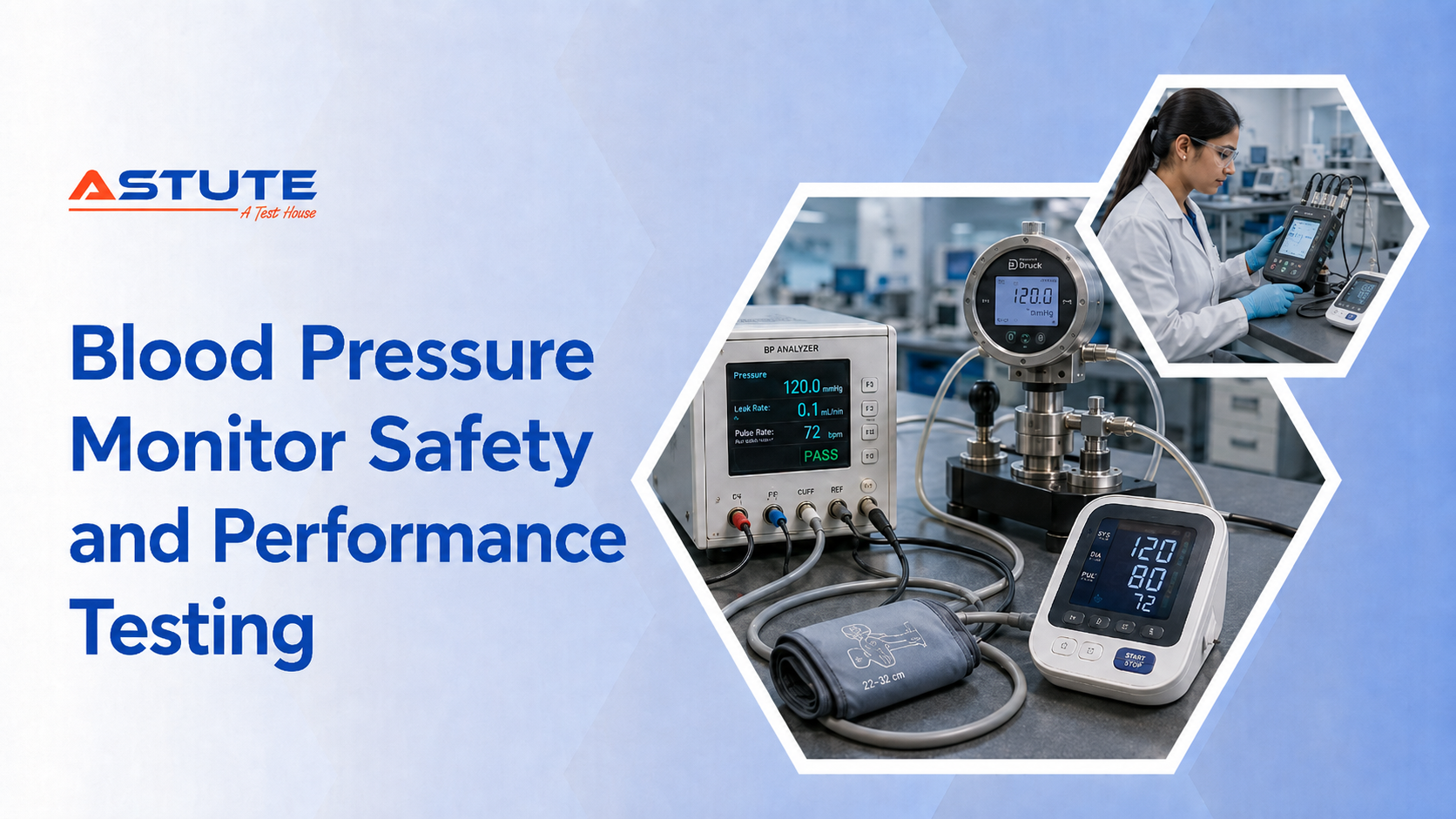
Accuracy, Cuff Performance, and EMC Reliability
Blood Pressure Monitor Validation for Accurate and Reliable Readings
Blood pressure monitors are among the most commonly used medical devices, but validating them is more complex than it appears.
A blood pressure monitor may be a common device, but validation errors can still derail compliance and market readiness.
These devices depend on a combination of pneumatic systems, sensors, and algorithms. Any gap in accuracy, cuff performance, or environmental stability can lead to incorrect readings and regulatory delays. IEC 80601-2-30 defines how these systems are tested to ensure safe and reliable performance.
IEC 80601-2-30 Blood Pressure Monitor Testing Requirements
IEC 80601-2-30 applies to automated non-invasive blood pressure monitors within the IEC 60601 framework.
It works alongside IEC 60601-1, IEC 60601-1-2, and ISO 14971 to ensure safety across electrical, environmental, and risk dimensions.
Clinical validation is handled through ISO 81060-2, which confirms whether the device delivers accurate readings across real patient populations .
Key Testing Areas in Blood Pressure Monitor Validation
Blood pressure monitors combine multiple systems, so testing focuses on how these perform together under real conditions.
Testing Area | What Is Checked | Why It Matters |
Measurement Accuracy | Systolic, diastolic, and MAP vs reference methods | Directly affects diagnosis and treatment |
Cuff Performance | Inflation/deflation, leakage, pressure distribution | Poor cuff behavior distorts readings |
Safety Controls | Pressure limits, deflation control, fail-safe response | Prevents patient injury |
EMC Reliability | Performance under RF interference and wireless exposure | Ensures stability in real-world environments |
Cuff Performance and Its Impact on Measurement Accuracy
The cuff plays a direct role in how pressure is applied and measured.
Even with a correct algorithm, inaccurate pressure transmission can lead to incorrect readings. Testing therefore focuses on air tightness, inflation and deflation behavior, and pressure distribution across the limb.
Another important change in recent standards is connector safety. Older connector designs created risks of accidental cross-connections. Modern requirements enforce dedicated connector systems to prevent such errors .
Safety Limits and Pressure Control in Blood Pressure Monitors
Blood pressure monitors must actively control applied pressure to avoid patient harm.
IEC 80601-2-30 defines clear safety limits:
- Overpressure protection must trigger below 300 mmHg for adult devices
- Lower thresholds apply for neonatal or sensitive use cases
- Pressure sensing systems must maintain static accuracy within ±3 mmHg
Devices must also ensure safe deflation under all conditions:
- Controlled release of pressure during normal operation
- Automatic deflation if power is lost
- Fail-safe response in case of system faults
These requirements ensure that even in abnormal situations, the device does not expose the patient to unsafe pressure levels.
EMC Reliability in Real-World Environments
Blood pressure monitors are often used outside controlled environments, especially in home settings.
This introduces exposure to electromagnetic interference from common sources like smartphones, Wi-Fi routers, and other electronics.
Testing ensures that devices can operate reliably under these conditions. For home healthcare environments, immunity levels are higher, typically requiring resistance to fields up to 10 V/m, with additional testing for wireless proximity exposure.
If interference affects performance, the device must indicate an error instead of displaying an incorrect reading .
Astute Labs supports this through EMI/EMC testing.
Blood Pressure Monitor Testing for Regulatory Compliance
IEC 80601-2-30 validation is expected for approvals under CDSCO, CE marking, and FDA pathways.
Delays often occur due to issues such as incomplete clinical validation, cuff-related inaccuracies, EMC failures, or gaps in documentation.
Working with Astute Labs helps identify these issues early. Their medical device testing services support manufacturers in preparing devices for compliance and submission.
Blood Pressure Monitor Validation for Safer Market Readiness
Blood pressure monitors require validation across multiple domains, including accuracy, mechanical performance, and environmental reliability.
IEC 80601-2-30 ensures that devices meet defined limits for measurement accuracy, maintain safe pressure control, and perform reliably in real-world conditions.
Early testing helps reduce rework, improve approval timelines, and ensure consistent device performance. Contact us