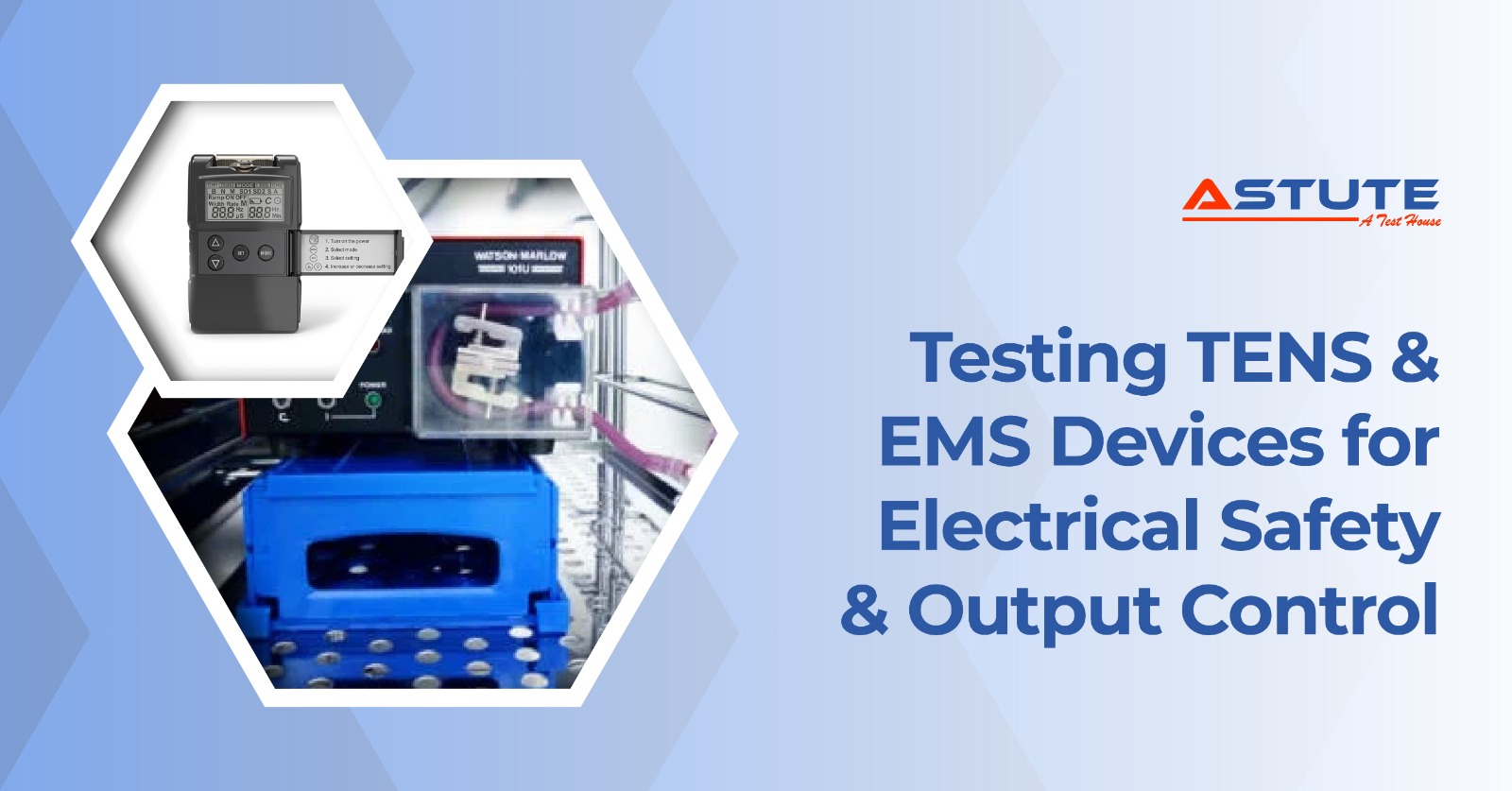
Physiotherapy devices such as TENS and EMS units do not just interact with the body. They deliver electrical current through it.
That makes testing far more critical than typical electrical devices. A small deviation in output, waveform, or current distribution can lead to burns, ineffective therapy, or unintended stimulation.
IEC 60601-2-10 defines how these devices must perform safely. It ensures that nerve and muscle stimulators deliver controlled electrical output, remain stable under different conditions, and prevent hazardous electrical exposure to patients.
What IEC 60601-2-10 Covers
IEC 60601-2-10 applies to nerve and muscle stimulators used in physiotherapy and rehabilitation. This includes:
- TENS devices for pain relief
- EMS systems for muscle stimulation
- Functional electrical stimulation systems
It works alongside general safety requirements. To understand the broader framework, refer to the IEC 60601-1 compliance guide for medical equipment.
The standard focuses on two key aspects:
- Electrical safety
- Controlled output performance
It does not apply to implantable stimulators or cardiac devices, which fall under separate standards due to higher physiological risk.
Why Output Control Is a Safety Requirement
The effectiveness of these devices depends on delivering precise electrical stimulation. However, excessive or unstable output creates direct risk.
Incorrect output can result in:
- Skin burns
- Muscle over-stimulation
- Pain or discomfort
- Ineffective therapy
This is why IEC 60601-2-10 treats output limits as part of essential performance, not just device functionality.
Electrical Output Limits and Safety Thresholds
The standard defines strict limits on voltage, current, and energy delivered to the patient. These limits are verified under different conditions to ensure safe operation.
Output Limit Overview
Parameter | Limit | Purpose |
Peak output voltage | Up to 500 V | Prevents excessive shock risk |
Energy per pulse | 300 mJ (max) | Prevents tissue damage |
Current density | 2 mA/cm² | Avoids localized burns |
DC component | 100 μA limit | Prevents chemical skin damage |
These limits are based on known thresholds for tissue safety and electrical exposure.
Waveform Accuracy and Pulse Control
TENS and EMS devices operate using controlled pulses, not continuous current.
Key parameters include:
- Pulse width
- Frequency
- Amplitude
- Waveform shape
If these parameters are not accurate, the therapy may not work as intended. In some cases, incorrect waveform delivery can cause discomfort or unsafe stimulation.
Manufacturers must ensure that waveform characteristics remain stable across different loads and settings.
Load Conditions and Real Use Testing
Human skin impedance is not constant. It changes depending on:
- Skin condition
- Electrode placement
- Moisture levels
- Contact quality
Devices must perform safely across a wide range of resistance values.
Load Simulation in Testing
Test Load | Simulation Scenario | Key Check |
10 kΩ | Dry skin or poor contact | Voltage control |
2 kΩ | Small electrode area | Output stability |
1 kΩ | Typical usage | Performance accuracy |
500 Ω | Standard test condition | Energy limit verification |
300 Ω | High conductivity skin | Current density check |
Testing across these conditions ensures safe performance in real-world use.
Leakage Current and Electrical Protection
Electrical safety is a critical part of compliance.
TENS and EMS devices typically use Type BF applied parts, which provide isolation between the patient and electrical circuits.
Testing focuses on:
- Patient leakage current
- Touch current
- Fault condition safety
Leakage current must remain within safe limits even if a failure occurs.
For deeper insight into test quality and compliance validation, refer to an accredited medical device testing lab and ISO IEC 17025 and IEC 60601 EMC test report quality in India.
Fault Conditions and Safe Failure
IEC standards require devices to remain safe even when faults occur.
Examples include:
- Circuit failure
- Software malfunction
- Output control errors
Devices must not deliver unintended stimulation under these conditions.
This is why structured validation approaches like pre-compliance EMC testing and medical device EMC failure mitigation under IEC 60601-1-2 are critical during development.
Electrode and Patient Interface Safety
Electrodes are the direct contact point with the patient.
Poor electrode performance can lead to:
- Uneven current distribution
- Localized heating
- Skin irritation or burns
Testing must ensure safe current density distribution across the electrode surface.
Regulatory Expectations for Compliance
Regulators assess whether the device is safe under real conditions, not just whether it meets nominal output values.
They expect:
- Accurate output validation
- Safe operation under fault conditions
- Consistency across modes
- Proper labeling and instructions
- Traceability between risk analysis and test results
Understanding the CDSCO approval process for medical devices in India and medical device testing requirements by class helps align compliance strategies.
Common Manufacturer Mistakes
Common issues that delay approvals include:
- Testing only nominal output values
- Ignoring impedance variation
- Weak waveform validation
- Poor fault condition testing
- Incomplete electrode evaluation
- Lack of traceability between risk and testing
These gaps often lead to rework and regulatory queries.
How Astute Labs Can Support
Testing physiotherapy and stimulation devices requires precise validation of electrical output and safety under multiple conditions.
Astute Labs supports manufacturers with medical device testing services and EMI EMC testing services. These services help ensure compliance with IEC standards and reduce approval delays. Contact us