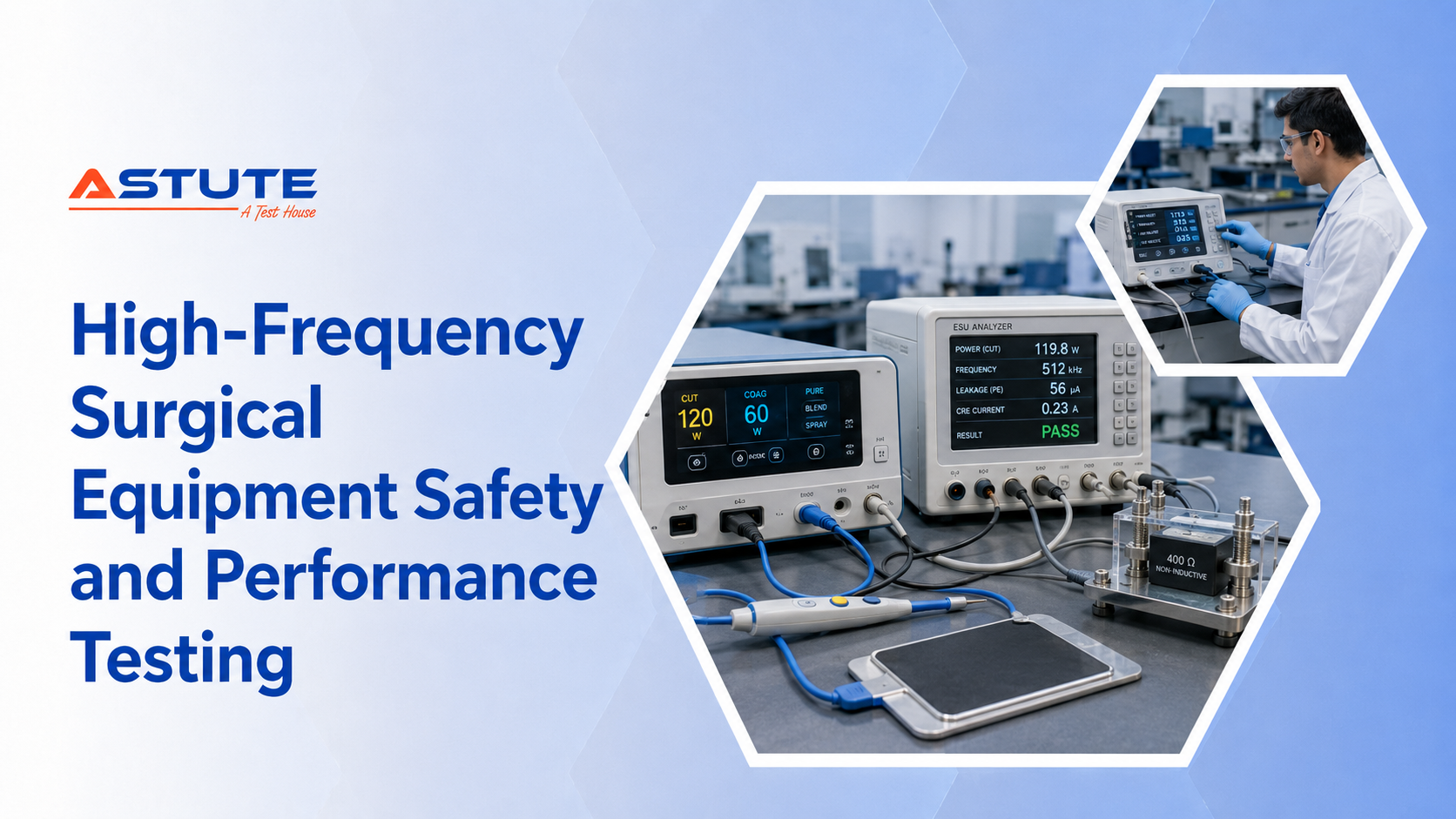
High-frequency surgical equipment is designed to cut, coagulate, and seal tissue using controlled electrical energy. Unlike most medical devices, these systems intentionally deliver energy into the body.
That makes control critical.
The risk is not whether energy is delivered. The risk is whether it stays within the intended path. Even small deviations can lead to unintended tissue damage, often not immediately visible during surgery.
IEC 60601-2-2 focuses on controlling these risks, especially those related to stray currents.
IEC 60601-2-2 Testing Requirements for Electrosurgical Equipment
IEC 60601-2-2 is a particular standard within the IEC 60601 framework.
It works alongside IEC 60601-1, IEC 60601-1-2, and ISO 14971 to ensure both safety and performance.
One key requirement defines a clear safety threshold. High-frequency leakage current to earth, measured through a defined test setup, must not exceed 150 mA through a 200 Ω load. This limit is critical in preventing unintended energy transfer to the patient.
Key Testing Areas in High-Frequency Surgical Equipment
Testing Area | What Is Checked | Why It Matters |
Output Performance | Power delivery across cut and coagulation modes | Ensures controlled energy delivery |
Stray Current Control | HF leakage current and unintended paths | Prevents internal burns and tissue damage |
Return Electrode Safety | Contact quality and monitoring systems | Reduces risk of burns at return site |
Accessory Integrity | Insulation, compatibility, and cable characteristics | Prevents energy diversion |
High Current Modes | Performance in high-duty cycle operations | Critical for vessel sealing and advanced systems |
EMC Reliability | Stability in electrically noisy environments | Ensures safe operation in operating rooms |
Stray Currents and RF Leakage in Electrosurgical Systems
At high frequencies, current does not behave like it does in low-frequency systems. It tends to follow multiple paths, especially when impedance drops.
This leads to three common risks:
- Leakage through insulation
- Capacitive coupling between instruments
- Direct coupling between conductive tools
In laparoscopic procedures, this becomes more dangerous. A large portion of the active electrode may be outside the surgeon’s field of view. If energy leaks or couples unintentionally, it can cause internal burns that may not be detected during surgery and may only present days later.
This is why stray current control is central to IEC 60601-2-2 testing.
Patient Return Electrode Safety and Contact Monitoring
In monopolar systems, energy flows through the patient and returns via a dispersive electrode.
Safety depends on maintaining a large contact area. When contact is reduced, current density increases, which can lead to burns.
Modern systems address this through Contact Quality Monitoring (CQM). This system continuously checks electrode contact and stops energy delivery if unsafe conditions are detected.
Return electrode failures remain one of the most common causes of electrosurgical injuries.
Active Accessories and Insulation Reliability
Accessories such as electrodes, forceps, and cables are part of the energy path and directly impact safety.
Testing focuses on:
- Insulation integrity under high-frequency conditions
- Resistance to voltage stress
- Durability with repeated use
The 2023 update adds two key requirements. Manufacturers must specify accessory length, as longer cables increase stray current risk. It also requires additional risk analysis for duty cycles above 45%, where continuous energy delivery can increase thermal risk.
EMC and Energy Interaction in Surgical Environments
Operating rooms contain multiple electronic systems, making electromagnetic interaction unavoidable.
High-frequency cables can behave like antennas, radiating energy and inducing current in nearby devices. This can affect monitoring systems or create unintended heating.
A practical consideration is waveform selection. Continuous “cut” modes typically operate at lower peak voltages compared to pulsed “coagulation” modes, which can reduce certain coupling risks in specific scenarios.
Testing under EMI/EMC testing ensures stable and safe performance in these environments.
High-Frequency Surgical Equipment Testing for Regulatory Compliance
Compliance with IEC 60601-2-2 is required for approvals under CDSCO, CE marking, and FDA pathways.
Common issues that delay approval include excessive leakage current, poor return electrode monitoring, accessory failures, and incomplete documentation.
Working with Astute Labs helps identify these risks early. Their medical device testing services support manufacturers in validating safety and performance before submission.
High-Frequency Surgical Equipment Testing for Safer Surgical Outcomes
High-frequency surgical systems must deliver energy precisely and safely.
IEC 60601-2-2 ensures that:
- Energy remains within controlled paths
- Stray currents are minimized
- Accessories perform reliably
- Systems operate safely under real conditions
Testing confirms that energy is delivered where intended and nowhere else.
Early validation reduces rework, improves approval timelines, and helps prevent critical clinical risks.
Frequently asked questions
01. What is IEC 60601-2-2 used for?
02. What are stray currents?
03. Why is the return electrode important?
It safely distributes current. Poor contact increases burn risk.