Optical Safety and Irradiance Control
Infant Phototherapy Equipment Testing for Neonatal Safety
Infant phototherapy equipment is used to treat neonatal jaundice by delivering controlled light to reduce bilirubin levels. While the treatment is simple in concept, the safety requirements are not.
An infant’s skin and eyes are highly sensitive. Too little light makes the treatment ineffective. Too much or poorly controlled exposure can introduce thermal and optical risks.
IEC 60601-2-50 defines how phototherapy equipment is tested to ensure that the right light is delivered, over the right area, in a safe and controlled way.
IEC 60601-2-50 Phototherapy Equipment Testing Requirements
IEC 60601-2-50 is part of the IEC 60601 framework and works alongside IEC 60601-1 and IEC 60601-1-2.
The standard focuses on:
- Optical output within the therapeutic range
- Irradiance uniformity across the treatment area
- Control of unwanted radiation such as UV and IR
- Stable performance during continuous operation
Key Testing Areas in Infant Phototherapy Equipment
Testing Area | What Is Checked | Why It Matters |
Irradiance Output | Light intensity within therapeutic range | Ensures effective treatment |
Uniformity | Distribution of light across surface | Prevents under or over exposure |
Spectral Range | Wavelength control in blue green region | Targets bilirubin absorption |
Optical Safety | UV and non therapeutic radiation limits | Protects infant skin and eyes |
Thermal Safety | Heat generation and exposure | Prevents overheating risk |
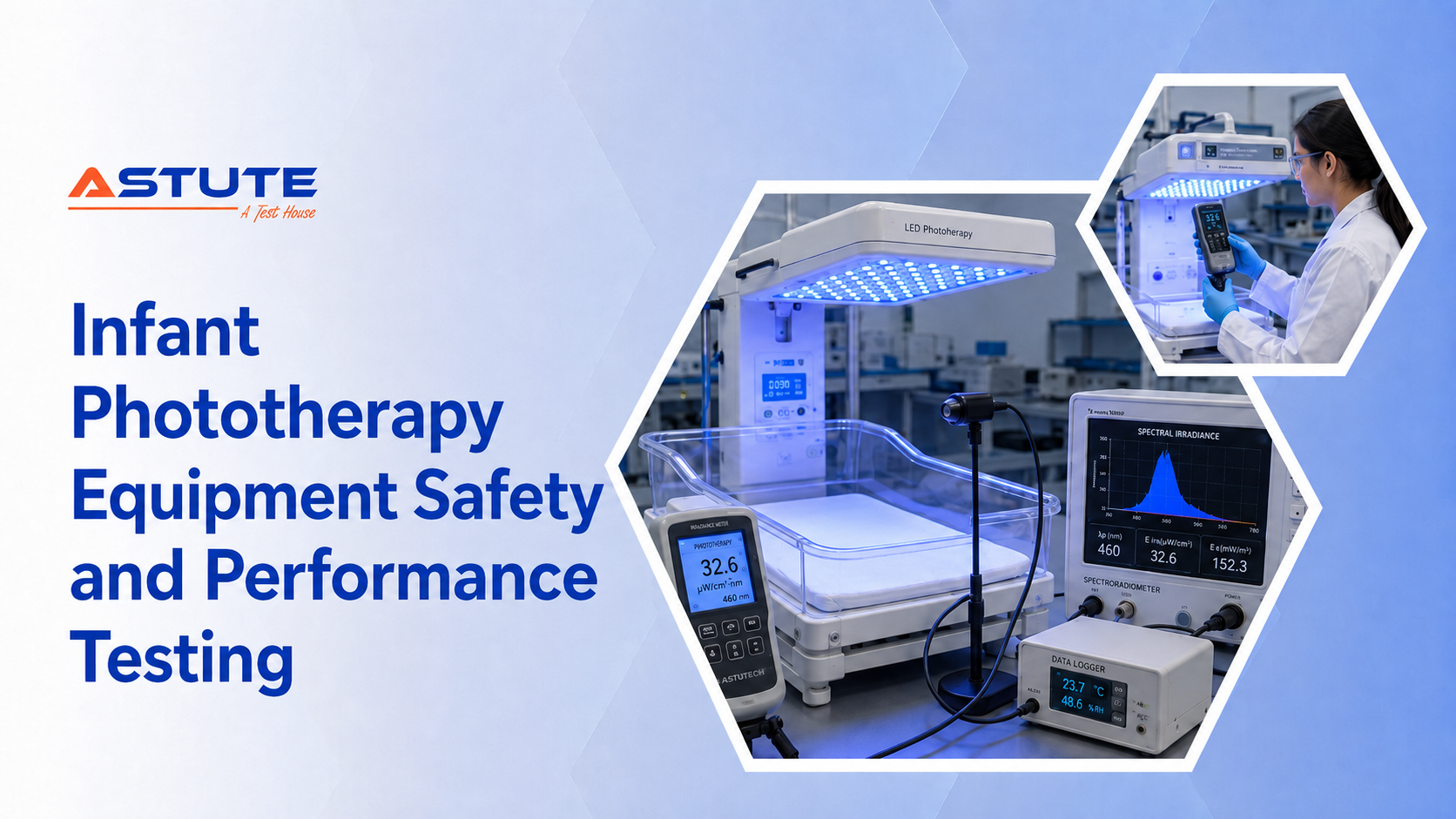
Effective Surface Area and Irradiance Uniformity
Testing does not measure light at a single point. It evaluates performance across the Effective Surface Area, where the infant is expected to receive treatment.
IEC guidance defines a structured approach:
- Measurement grid based on approximately 60 cm by 30 cm area
- Points spaced no more than 10 cm apart
- Uniformity ratio must be at least 0.4
This ensures consistent exposure across the infant’s body. Without uniformity, some areas may receive excessive light while others receive too little.
Irradiance Control and Therapeutic Performance
The effectiveness of phototherapy depends on delivering light within a specific wavelength range, typically between 400 nm and 550 nm.
Testing ensures:
- Output remains within the therapeutic spectrum
- Maximum irradiance stays within safe limits
- Performance remains stable over time
An additional requirement is source degradation monitoring. The system must alert the user when irradiance drops significantly, typically around a 25 percent reduction from initial output.
This helps maintain consistent treatment effectiveness.
Optical Safety and Control of Unwanted Radiation
Phototherapy equipment must control radiation outside the therapeutic range.
Ultraviolet exposure is strictly limited to prevent long term risks such as skin damage or cellular effects.
Infrared radiation must also be controlled. Excess heat can increase the risk of dehydration or hyperthermia in neonates.
Optical safety therefore focuses on delivering only the required wavelengths while minimizing unnecessary exposure.
Thermal Safety in Neonatal Environments
Phototherapy devices are often used alongside incubators or radiant warmers. This creates a combined thermal environment that must be evaluated carefully.
Testing considers:
- Temperature rise near the infant
- Interaction with other thermal equipment
- Surface temperature of accessible parts
Even small temperature increases can affect neonatal stability, so thermal control is a critical requirement.
Infant Phototherapy Equipment Testing for Regulatory Compliance
IEC 60601-2-50 compliance supports approvals under CDSCO, CE marking, and FDA pathways.
Common issues that delay approval include:
- Incorrect irradiance measurement
- Poor uniformity across the treatment area
- Output drift over time
- Incomplete documentation of effective treatment area
Working with Astute Labs helps manufacturers identify these gaps early. Their medical device testing services support validation across safety and performance requirements.
For reliability in clinical environments, supporting services like EMI/EMC testing ensure stable operation in NICU settings.
Infant Phototherapy Equipment Testing for Safe and Effective Treatment
Phototherapy equipment must balance effectiveness and safety.
IEC 60601-2-50 ensures that:
- Light is delivered within the correct spectrum
- Exposure is uniform across the treatment area
- Unwanted radiation is minimized
- Thermal risks are controlled
Testing confirms that treatment is both effective and safe for neonatal care. Contact us